
HR Generalist Essentials
Handle the everyday work of an HR generalist, from hiring and pay to performance, complaints and policy, with sound process and good judgement.
- 20 chapters in 5 modules
- About 8½ hours, self-paced
- 20 interactive exercises
- Verifiable certificate
US$49 one-time, tax included
- Ongoing access, updates included
- Certificate you can add to LinkedIn
- 14-day refund if it isn't right for you
What you'll be able to do
- Explain what HR is for and map the whole employee lifecycle
- Apply the legal ground rules of employment and know when to check local law
- Run structured, fair hiring and a first 30 days that sets people up to succeed
- Answer pay and payslip questions and support managers through fair performance processes
- Handle confidential information, grievances and safety risks with sound process
- Run the day-to-day HR function: triage requests, report core metrics and work well with managers
Is it for you?
It's for
- New HR generalists, HR coordinators and HR administrators
- Line managers and small-business owners who carry HR responsibilities without an HR team
- People moving into HR from operations, recruitment or payroll
It isn't for
- Experienced HR business partners or specialists
- Anyone looking for jurisdiction-specific legal advice: this course teaches principles and tells you what to check locally
Free preview, no sign-in
Try a real exercise from the course
This is the exercise from chapter 10, “Performance management essentials”, in module 3(Pay, performance and development). Every chapter has one like it. Your answers are saved on this device only.
Exercise · about 12 minutes
"I want them gone"
A manager wants an underperforming employee out by the end of the month. Guide him through a process that is fair to her, defensible for the organisation and still useful to him. After each choice you'll see what happened and why.
The situation
You're the HR generalist at a 150-person freight and logistics company. Owen manages the dispatch team of eight. Talia has been a dispatch coordinator there for four years, with solid reviews until this year.
Decision 1
Owen, dispatch manager
"Got a minute? It's Talia. She's been hopeless for months, and last week she missed two carrier bookings. The hospital supplies client nearly walked. I want her out by the end of the month. Can you sort the paperwork?"
What's inside
20 chapters, each with a written lesson, an interactive exercise and a short knowledge check. About 8½ hours in total, including roughly 4½ hours of exercises. Finish with a 20-question final assessment.
-
Module 1. Foundations
What HR is for, the employee lifecycle, how HR teams are organised and who you serve.
-
1
20 min
What HR is for
What HR exists to do, and how to tell administrative, operational and strategic work apart so the urgent stops crowding out the important.
-
2
20 min
The employee lifecycle
The six stages every employee moves through, from first hearing about you to leaving, and why most people problems start at the handovers between them.
-
3
23 min
How HR is organised
The four common ways to structure an HR function, what each is good and bad at, and how to tell which mix fits an organisation.
-
4
24 min
HR's stakeholders
Who HR works for and with, what each group needs from you, and how to keep the trust of leaders, managers, employees and their representatives at once.
-
1
-
Module 2. Hiring and onboarding
The legal ground rules, planning headcount, hiring fairly and a strong first month.
-
5
27 min
Employment law ground rules
The four questions to ask about any working arrangement: status, contract, minimum entitlements and discrimination, and when to check local law.
-
6
22 min
Workforce planning in brief
Work out how many people you need to hire this year, why replacing leavers often outweighs growth, and how time-to-fill shapes the workload.
-
7
31 min
Recruitment and selection essentials
Turn a role brief into clear criteria, an inclusive job ad and a structured interview that compares candidates fairly and stays lawful.
-
8
21 min
Onboarding essentials
Plan a new starter's first 30 days in four stages, so they arrive ready, feel welcome and are doing real work within the month.
-
5
-
Module 3. Pay, performance and development
Payroll basics, fair performance management, the right development fix and listening to staff.
-
9
24 min
Pay, benefits and payroll basics
Read a payslip line by line, explain the gap between gross and net pay, and spot the payroll errors that cost trust fastest.
-
10
24 min Try it free
Performance management essentials
Help a manager deal with underperformance fairly: a clear gap, real support, reasonable time and a record that would stand up to review.
-
11
18 min
Learning and development essentials
Work out whether a capability gap needs a course, coaching, on-the-job practice or no training at all, and check the fix worked.
-
12
25 min
Engagement and culture
What engagement and culture mean in practice, how to listen to staff without survey fatigue, and how to write pulse questions worth answering.
-
9
-
Module 4. Relations, risk and compliance
Confidentiality, grievances, health and safety, and policies people can actually follow.
-
13
27 min
Confidentiality, ethics and trust in HR
Decide what you can share, with whom and why, so people trust HR with sensitive information and managers still get what they need.
-
14
24 min
Employee relations essentials
Receive a complaint well, choose between informal and formal routes, and run a grievance process that is fair to everyone involved.
-
15
27 min
Health, safety and wellbeing basics
Spot hazards, rate risks with a simple matrix and choose controls that work, including for psychosocial risks and people working from home.
-
16
26 min
HR policies and the handbook
Write policies people can follow, keep the handbook current, and make sure policy, contract and law all point in the same direction.
-
13
-
Module 5. Running the HR function
Triage the workload, report the numbers, partner with managers and plan your own growth.
-
17
27 min
The HR generalist's day
How to triage a full HR inbox by urgency, risk and owner, set response times people can rely on, and close every request properly.
-
18
32 min
HR data, systems and reporting
Calculate headcount, turnover, absence and time to fill correctly, keep HR data clean and private, and turn each number into a useful question.
-
19
26 min
Working with managers as an HR partner
How to advise managers so they make fair, lawful people decisions, including how to refuse an unfair request and still offer a way forward.
-
20
30 min
Your HR development plan
Rate yourself honestly across eight HR capability areas, choose three to develop, and build a 12-month plan with real actions and dates.
-
17
This course is educational and isn't legal advice. Legal topics are taught as principles, with notes on how Australia, the UK and the US differ, so you know what to check where you work.
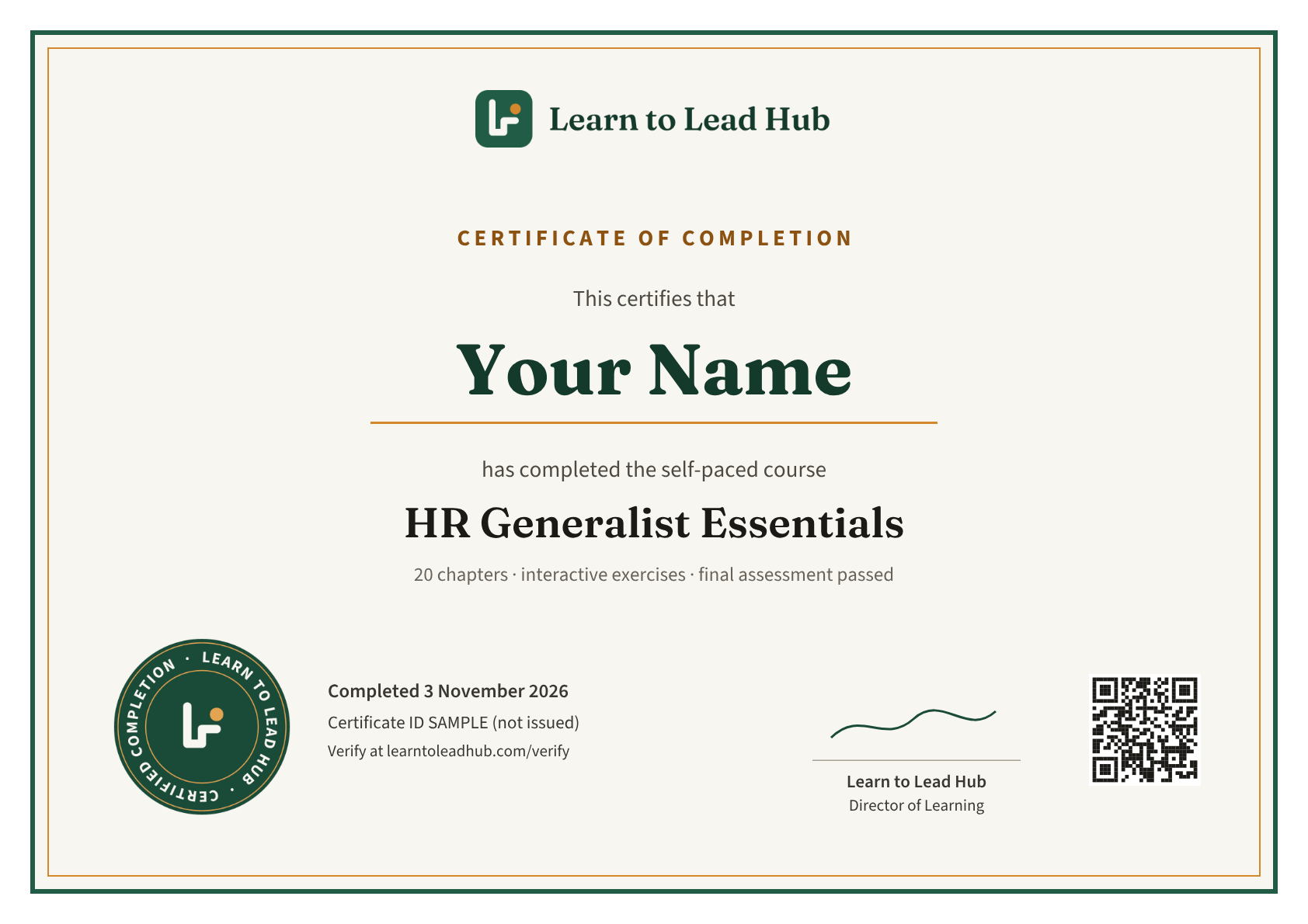
A certificate anyone can check
Complete every chapter, attempt every exercise and pass the final assessment with 80% or more (retake it as often as you like). You get an A4 PDF with your name, the course, the date and a unique certificate ID. It's a certificate of completion, not an accredited qualification.
- Verifiable: its QR code and link open a public page at learntoleadhub.com/verify confirming it's genuine.
- On LinkedIn in one click: the “Add to LinkedIn profile” button fills in the course, issuer, date, ID and link for you.
- Ready to share: a square badge image and suggested post text come with it.
US$49, once. No subscription.
No subscription and nothing to renew. You keep access for as long as Learn to Lead Hub operates, and if it ever closes you'll get at least 90 days' notice to finish and download your certificate. If the course isn't right for you, ask within 14 days for a full refund.
Secure checkout by Stripe. The sale is made by Link, Stripe's checkout service, on our behalf: it takes the payment, adds any local sales tax and emails your receipt, so your card statement shows LINK.COM*. We provide the course and handle refunds. Prices are in US dollars; Checkout may show the amount in your currency.
Questions
Is this legal advice?
No. The course teaches the principles behind fair, lawful HR practice and tells you what to check where you work, with short notes for Australia, the UK and the US. For a decision about a real person, check your local law or get qualified advice.
Which country is it for?
It's written for HR generalists anywhere. Legal topics are explained as principles first, with notes on how Australia, the UK and the US differ, so you know what to look up locally.
I manage people but I'm not in HR. Is it for me?
Yes, if you handle hiring, pay questions, performance issues or complaints without an HR team. It's not for experienced HR business partners.
How long do I have access?
For as long as Learn to Lead Hub operates, including updates to the course. If we ever close, we'll give at least 90 days' notice so you can finish and download your certificate.
Do I get a certificate?
Yes. Finish every chapter, attempt every exercise and pass the 20-question final assessment (80% or more, unlimited retakes) to get a PDF certificate with your name and a unique ID. Anyone can check it at learntoleadhub.com/verify. It's a certificate of completion from Learn to Lead Hub, not an accredited or government-recognised qualification.
Is there a refund policy?
Yes. If a course isn't right for you, ask within 14 days of purchase for a full refund. Refunding ends access to that course.
Who is the seller and how do I pay?
Checkout is hosted by Stripe. The sale itself is made by Link, Stripe's checkout service, on our behalf: Link takes your payment, adds any sales tax, VAT or GST that applies where you live, and emails your receipt. That's why your card statement shows LINK.COM* rather than our name. We provide the course, your access and support, including refunds. Prices are set in US dollars and Checkout may show the amount in your local currency.
Is there video?
No. Chapters are written lessons with worked examples, so you can read at your own speed, search, and come back to them on any device.
Can my employer pay, or can I buy for my team?
Your employer can buy a course for you using your work email, or contact us (choose “Buying for a team”) about access for a group.
Free reading on these topics
-
How to run a fair disciplinary process, step by step
How to run a fair disciplinary process from first report to appeal: what to check, how to frame allegations, how to decide, and what to write down.
-
HR generalist first 90 days checklist, week by week
A practical HR generalist first 90 days checklist: who to meet, what to check, what to fix first and what to leave alone until you understand the place.
-
What does an HR generalist actually do?
What an HR generalist actually does all week: the tasks at each stage of employment, how the work is split, what it isn't, and the skills it calls for.
US$49 one-time · 14-day refund