
Business Skills Essentials
Read the numbers, make sound calls, write so people act, and get work done through others.
- 20 chapters in 5 modules
- About 8½ hours, self-paced
- 20 interactive exercises
- Verifiable certificate
US$49 one-time, tax included
- Ongoing access, updates included
- Certificate you can add to LinkedIn
- 14-day refund if it isn't right for you
What you'll be able to do
- Read an income statement and explain why a profitable business can still run out of cash
- Work out whether a product makes money on each customer
- Define a problem properly, find its root cause and choose between options with a clear method
- Write answer-first messages, plain-language rewrites and one-page briefs that get decisions
- Set expectations, give feedback and delegate without micromanaging
- Prioritise your week and set goals and measures that show real progress
Is it for you?
It's for
- People in their first years of professional work who want to understand how the business really runs
- Anyone stepping into a role with a budget, people or decisions to own
- Specialists (engineers, designers, analysts, clinicians) moving into team lead or project roles
It isn't for
- Finance professionals: the money chapters are foundations, not advanced analysis
- Experienced managers who already run budgets and teams comfortably
Free preview, no sign-in
Try a real exercise from the course
This is the exercise from chapter 3, “Cash flow: why profit isn't cash”, in module 1(How a business works). Every chapter has one like it. Your answers are saved on this device only.
Exercise · about 12 minutes
The profitable company that ran out of cash
Tidewater Trade Supplies sells packaging and dry goods to cafés and restaurants. After winning several new accounts, its sales of $150,000 a month are growing 5% a month. It keeps 28 cents of each dollar after cost of sales, overheads are $32,000 a month, and it starts the year with $40,000 in the bank and no overdraft. On today's terms (customers pay in 60 days, Tidewater pays its suppliers in 30, and it holds 75 days of stock) the business is profitable and heading into the red. Change the three levers to keep at least $20,000 in the bank every month. Every change has a cost in real life, so look for the smallest set of moves that works.
Your challenge
Keep at least $20,000 in the bank every month of the year
Not met yet.
Profit over 12 months
$284,519
Lowest bank balance
−$24,164
Bank balance at month 12
−$20,243
Months overdrawn
9
Tidewater spends more than half the year overdrawn, while making about $285,000 of profit. A bank asked to fund an overdraft this long will want a plan, not a profit forecast.
Profitable on paper, overdrawn in the bank. Each month's sales are bigger than the last, so Tidewater is always paying for stock for a bigger month while collecting cash for a smaller one. Open the table and compare cash in with cash out.
Watch the lowest bank balance and the month it happens, not the profit. Try one lever at a time first: customers from 60 to 45 days, suppliers from 30 to 45, or stock from 75 to 60 each lifts the low point by between about $27,000 and $33,000 on its own.
Show the numbers
| Month | Sales | Cash in | Cash out | Balance |
|---|---|---|---|---|
| Jan | $150,000 | $136,054 | $147,714 | $28,340 |
| Feb | $157,500 | $142,857 | $153,500 | $17,697 |
| Mar | $165,375 | $150,000 | $159,575 | $8,122 |
| Apr | $173,644 | $157,500 | $165,954 | −$331 |
| May | $182,326 | $165,375 | $172,651 | −$7,608 |
| Jun | $191,442 | $173,644 | $179,684 | −$13,648 |
| Jul | $201,014 | $182,326 | $187,068 | −$18,390 |
| Aug | $211,065 | $191,442 | $194,822 | −$21,770 |
| Sep | $221,618 | $201,014 | $202,963 | −$23,718 |
| Oct | $232,699 | $211,065 | $211,511 | −$24,164 |
| Nov | $244,334 | $221,618 | $220,486 | −$23,032 |
| Dec | $256,551 | $232,699 | $229,911 | −$20,243 |
What's inside
20 chapters, each with a written lesson, an interactive exercise and a short knowledge check. About 8½ hours in total, including roughly 5 hours of exercises. Finish with a 20-question final assessment.
-
Module 1. How a business works
Where the money comes from, where it goes, and why profit and cash are different things.
-
1
24 min
Follow the dollar: how your organisation makes money
Trace one dollar of revenue through costs, interest and tax to the cents that are left, and find the line your own work changes.
-
2
25 min
Reading an income statement
A six-step method for reading two years of an income statement and explaining what really changed, in plain words.
-
3
23 min Try it free
Cash flow: why profit isn't cash
Why a profitable business can still run out of money, and the three levers that decide when cash arrives and leaves.
-
4
23 min
Unit economics
Work out whether a product makes money on each customer, using contribution, acquisition cost, retention, lifetime value and payback.
-
1
-
Module 2. Making good decisions
Frame the real problem, find its cause, weigh options and catch your own biases.
-
5
24 min
Defining the problem properly
Turn a request for a solution into a clear problem statement, so you fix what is actually wrong before anyone spends money.
-
6
23 min
Finding the root cause
Use the 5 Whys and a fishbone diagram to get past symptoms to the causes worth fixing, and test a cause before you act on it.
-
7
23 min
Decision frameworks that actually help
When to use a pros and cons list, a weighted-criteria matrix or a decision tree, and how to test whether your answer depends on one weight.
-
8
26 min
Cognitive biases in everyday decisions
Six common thinking traps that skew workplace decisions, how to recognise each one, and a practical counter-move for every one of them.
-
5
-
Module 3. Communication that lands
Lead with the point, write plainly, brief decision-makers and deliver hard news well.
-
9
21 min
Structure your message: answer first
Put your conclusion and your request in the first two lines, then the reasons and evidence beneath, so busy readers can act on what you send.
-
10
26 min
Clarity and plain language
Write so people understand you the first time: shorter sentences, everyday words, and verbs that say who does what.
-
11
31 min
Executive summaries for busy decision-makers
Turn a long report into a one-page brief a senior reader can decide from: bottom line, context, options, recommendation and a clear ask.
-
12
23 min
Delivering difficult messages and bad news
Deliver bad news early, plainly and humanely: lead with the headline, answer the hardest question honestly and leave people with next steps.
-
9
-
Module 4. Working with people
Clear expectations, useful feedback, sensible delegation and better difficult conversations.
-
13
29 min
Setting clear expectations
Turn a vague request into an expectation someone can act on and you can both check: outcome, standard, deadline, measure and support.
-
14
25 min
Feedback fundamentals
Give feedback people can use: show you're on their side, say the hard part plainly, and use situation, behaviour and impact to make it specific.
-
15
28 min
Delegation
Choose how much to hand over, from tell to delegate, based on the person and the stakes, so you neither hover nor walk away.
-
16
31 min
Preparing for a difficult conversation
Prepare for a hard conversation in 20 minutes: separate facts from your story, think through their view, and write an opening that invites a reply.
-
13
-
Module 5. Planning and getting things done
Make room for strategic work, prioritise, set OKRs and measure progress with the right KPIs.
-
17
31 min
Operational vs strategic thinking
Why urgent daily work crowds out the thinking your role needs, and how a one-week time audit helps you win back protected hours.
-
18
25 min
Goal-setting and prioritisation
Set a few clear goals, then sort each week's tasks by urgency and importance so the work that matters gets done before it becomes a crisis.
-
19
30 min
OKRs: objectives and key results
Write an objective that sets direction and three key results that measure real outcomes, with a baseline and target, rather than a list of tasks.
-
20
28 min
Measuring progress with KPIs
Choose a few KPIs that pair an early warning with the final result, so you know whether you're on track while there's still time to act.
-
17
A certificate anyone can check
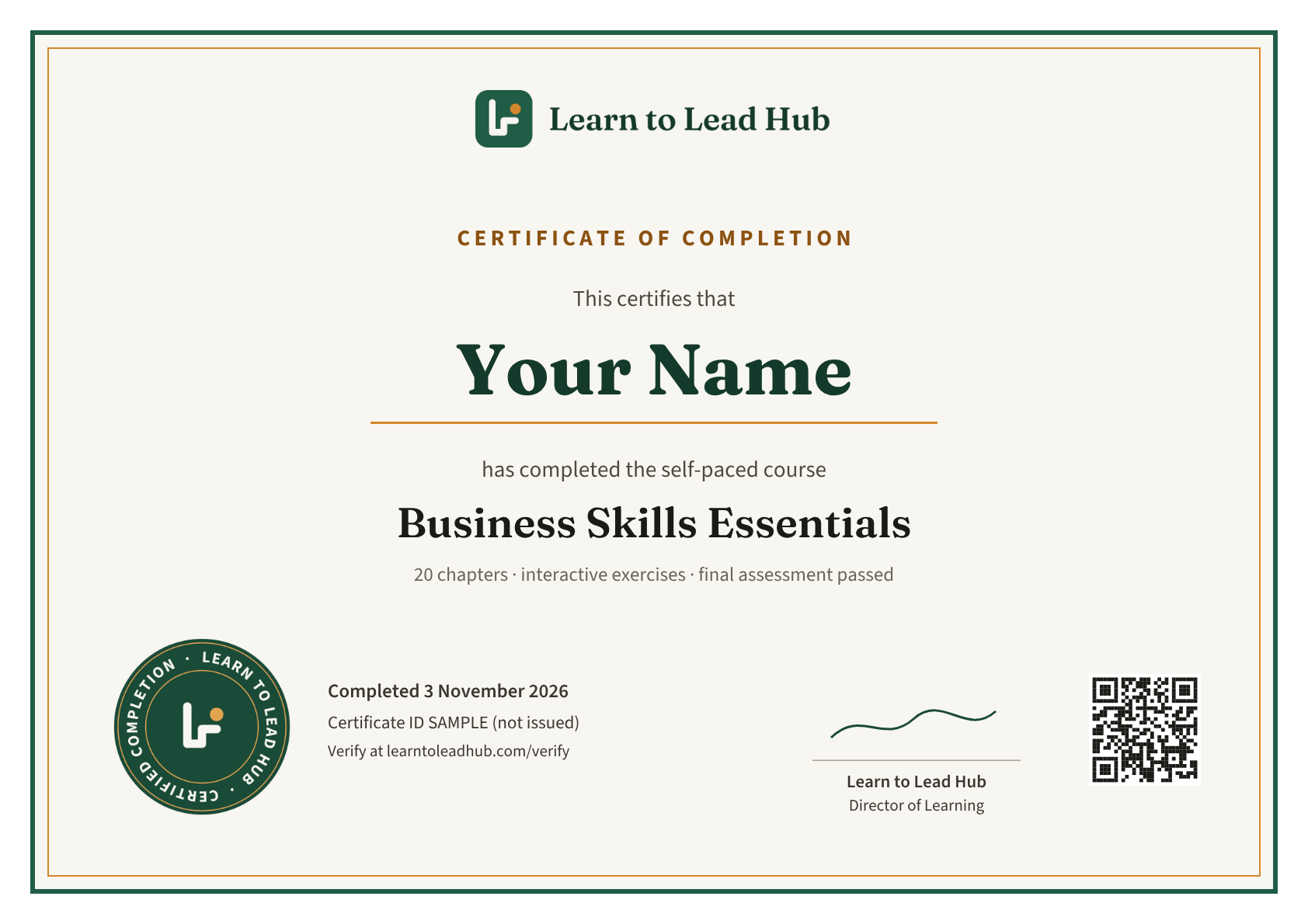
Complete every chapter, attempt every exercise and pass the final assessment with 80% or more (retake it as often as you like). You get an A4 PDF with your name, the course, the date and a unique certificate ID. It's a certificate of completion, not an accredited qualification.
- Verifiable: its QR code and link open a public page at learntoleadhub.com/verify confirming it's genuine.
- On LinkedIn in one click: the “Add to LinkedIn profile” button fills in the course, issuer, date, ID and link for you.
- Ready to share: a square badge image and suggested post text come with it.

US$49, once. No subscription.
No subscription and nothing to renew. You keep access for as long as Learn to Lead Hub operates, and if it ever closes you'll get at least 90 days' notice to finish and download your certificate. If the course isn't right for you, ask within 14 days for a full refund.
Secure checkout by Stripe. The sale is made by Link, Stripe's checkout service, on our behalf: it takes the payment, adds any local sales tax and emails your receipt, so your card statement shows LINK.COM*. We provide the course and handle refunds. Prices are in US dollars; Checkout may show the amount in your currency.
Questions
Do I need a finance background for the money chapters?
No. The first module starts from where a dollar of revenue goes and builds up to reading an income statement, cash flow and unit economics, with every number worked through.
Is this a management course?
Partly. It covers the business skills anyone in their first professional years or a new lead role needs: money, decisions, communication, working with people and planning. It isn't a course in managing large teams.
I'm already a manager. Is it too basic?
If you already read P&Ls, write one-page briefs and delegate comfortably, probably yes. Check the chapter list on the course page: the course works best when at least half the chapters are new to you.
How long do I have access?
For as long as Learn to Lead Hub operates, including updates to the course. If we ever close, we'll give at least 90 days' notice so you can finish and download your certificate.
Do I get a certificate?
Yes. Finish every chapter, attempt every exercise and pass the 20-question final assessment (80% or more, unlimited retakes) to get a PDF certificate with your name and a unique ID. Anyone can check it at learntoleadhub.com/verify. It's a certificate of completion from Learn to Lead Hub, not an accredited or government-recognised qualification.
Is there a refund policy?
Yes. If a course isn't right for you, ask within 14 days of purchase for a full refund. Refunding ends access to that course.
Who is the seller and how do I pay?
Checkout is hosted by Stripe. The sale itself is made by Link, Stripe's checkout service, on our behalf: Link takes your payment, adds any sales tax, VAT or GST that applies where you live, and emails your receipt. That's why your card statement shows LINK.COM* rather than our name. We provide the course, your access and support, including refunds. Prices are set in US dollars and Checkout may show the amount in your local currency.
Is there video?
No. Chapters are written lessons with worked examples, so you can read at your own speed, search, and come back to them on any device.
Can my employer pay, or can I buy for my team?
Your employer can buy a course for you using your work email, or contact us (choose “Buying for a team”) about access for a group.
Free reading on these topics
-
How to give feedback to a defensive employee: what to say
What to say before, during and after feedback when an employee gets defensive, with example responses to pushback and a step list you can use this week.
-
How to read a profit and loss statement: a manager's guide
A plain-English method for non-finance managers to read a profit and loss statement, spot what really changed and ask finance the right questions.
-
OKRs vs KPIs explained simply, with examples
The difference between OKRs and KPIs in plain words, how the two work together, and a worked example showing when a KPI should become a key result.
US$49 one-time · 14-day refund